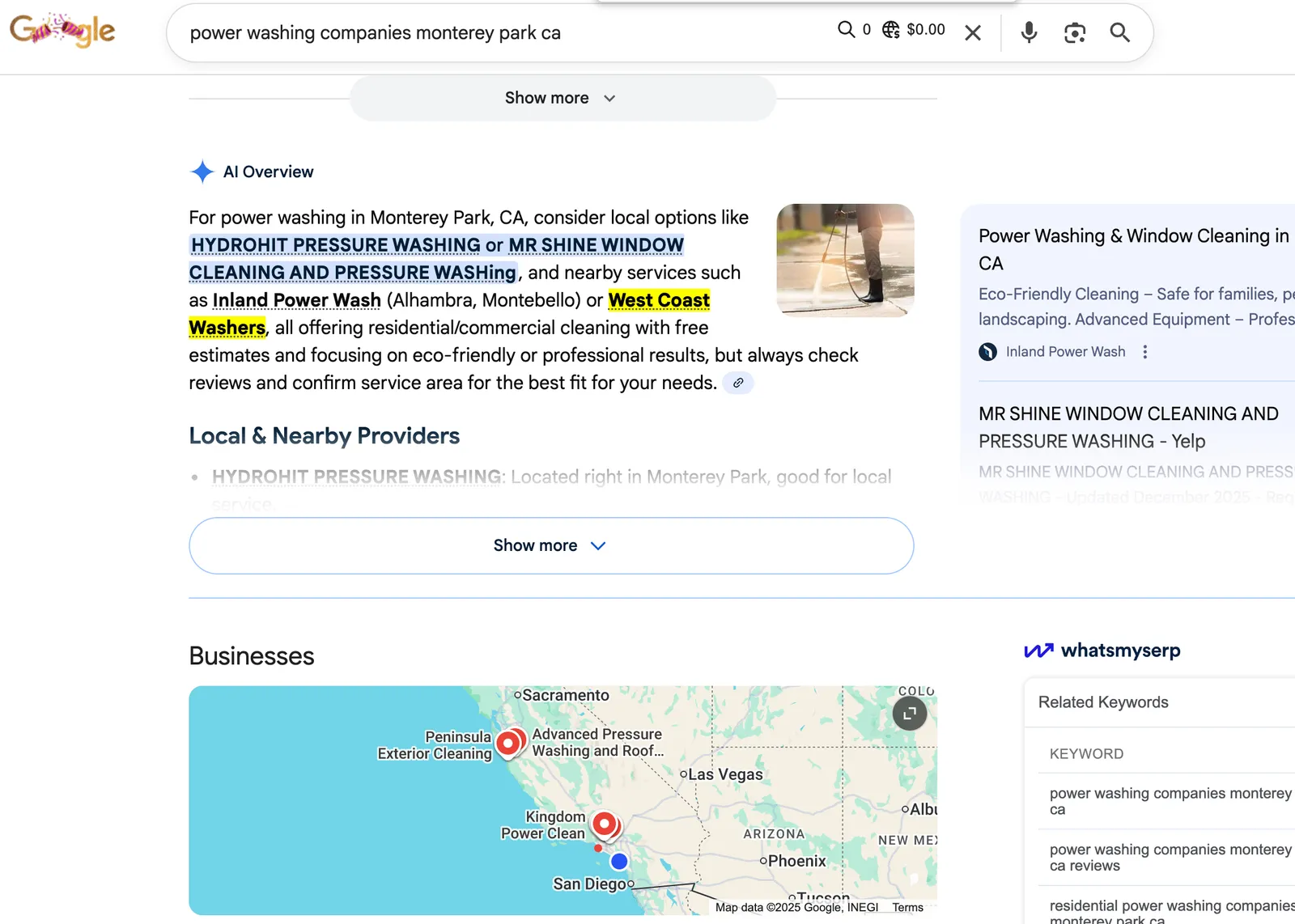
You get named in an AI answer when the sources those tools read already describe you as an HVAC company that does this work in this city. AI tools do not pick a favorite. They assemble an answer from a profile, reviews, directory listings, forum threads, roundup articles and your own website. If those pieces are thin or inconsistent, the answer names someone else.
Here's the short version:
- Homeowners now ask ChatGPT and other AI tools who to hire, and that includes replacement and maintenance work.
- An HVAC answer is built from your profile, your reviews, directory listings, Reddit threads, best of articles and your website.
- Across more than 70,000 AI citations we have tracked for clients, Houzz and Reddit come up as cited sources far more than anything else, followed by directories and best of articles.
- Coastal Comfort, an HVAC and plumbing client in San Diego, went from 2 percent to 43 percent of tracked AI answers naming them.
- Fix the pieces in order: profile and services, reviews, listings, off site mentions, then the site itself.
Why This Matters For Replacement and Maintenance Work
The homeowner with a dead compressor in August still calls the first number they find. That has not changed. What has changed is the customer who is planning, not panicking. The one pricing a system replacement, comparing ductless to ducted, or deciding whether a maintenance plan is worth it. That person opens a chat window and types something like who are the best HVAC companies near me, or how much does a new AC system cost in my area and who installs them.
Those are the jobs with the largest tickets and the longest consideration window. If an AI tool hands back three company names and you are not one of them, you were never in the running. The homeowner does not know you exist, and you have no way to tell that you lost the job, because there was no call and no form fill to measure.
This is the same shift that is reshaping ordinary search results. We wrote about that in more detail in how Google search is changing and what local businesses need to know, and the AI answer layer sits on top of it.
What An HVAC Answer Is Actually Built From
When we track AI visibility for clients, we run a set of real customer prompts for the trade and the cities, on a schedule, across six AI engines. We record whether the business was named, where in the answer it appeared, and which sources the answer cited. That last part is what tells you where the work has to happen.
For HVAC companies, the sources that show up look like this:
The Google Business Profile. Heating, cooling and ductless listed as separate services, not one line that says HVAC. Categories set correctly. Hours, service area and photos current.
Reviews that name the equipment and the city. A review that says they replaced our furnace in Fullerton is a source an AI engine can use. A review that says great service is not. Review volume matters less than review language.
Yelp and directory listings. Consistent name, address, phone and service list across the places that get crawled. Inconsistency is why some companies get named in one engine and never in another.
Reddit threads. Homeowners ask for HVAC recommendations in city subreddits constantly, and AI engines cite those threads heavily.
Best HVAC articles and listicles. Roundups of HVAC companies in a city get read and cited as if they were authoritative, because to an AI engine they look like a human comparison already done.
Your own website. Pages that answer the questions a homeowner asks out loud. What a system replacement runs, how long an install takes, what maintenance covers, what ductless is good for. If your site has nothing on cost or timeline, there is nothing for an answer to pull from.

A homeowner typing an HVAC question into an AI chat window instead of a search bar.
The Order To Fix It
Order matters here, because the later items only pay off once the earlier ones are solid.
First, the profile and the service list. This is the cheapest fix and the one most HVAC companies have left half done. Heating, cooling, ductless, maintenance, repair, each listed. Ongoing posts and photo uploads keep it active.
Second, reviews. Not just more of them. Reviews that mention the city and the equipment. That means asking at the right moment and making the ask easy, which is what a review request integration is for.
Third, listings. Get the name, categories and service list consistent across the directories AI engines read. This is unglamorous cleanup work and it moves the needle.
Fourth, off site mentions and citations. Placements on the sites AI engines actually read and cite, including the directories and best of articles that keep appearing in tracked answers.
Fifth, the website. Service pages and location pages that answer cost and timeline questions in plain language, with structured data and an llms.txt file so AI crawlers can read it cleanly. Every site we build ships with both.
| Piece | What it does for AI answers | How fast it moves |
|---|---|---|
| Profile and service list | Gives engines a clear statement of what you do and where | Fast |
| Reviews naming city and equipment | Supplies quotable, specific evidence | Steady |
| Directory and Yelp listings | Makes your details consistent everywhere | Moderate |
| Reddit and best of mentions | Supplies the sources engines cite most | Slower, compounds |
| Website pages on cost and timeline | Gives the answer something to quote and link | Moderate |
What Progress Looks Like
Coastal Comfort is an HVAC and plumbing client in San Diego. When we started tracking, they were named in 2 percent of the AI answers we ran for their trade and cities. That number is now 43 percent. Nothing about that was a trick. It was the profile, the reviews, the listings, the citations and the site, worked in order, over months.
That is also why our plans start with a six month commitment before going month to month. Off site citations and review language do not accumulate in three weeks. Our SEO plans include a three month out, so if there is no measurable improvement by month three you can stop.
If you want the fuller explanation of how generative engines assemble answers, we wrote a plain English guide to generative engine optimization for contractors that covers the mechanics without the jargon.
Where This Sits Alongside Regular Local SEO
AI visibility is not a replacement for ranking in the map pack. It runs on most of the same inputs. A clean profile, real reviews, consistent listings and a fast site with clear service pages help you in both places. That is why our Local SEO work and our AI Search Visibility tracking are built on the same foundation rather than sold as unrelated projects.
The difference is measurement. Rankings you can see. AI answers you cannot, unless someone is running the prompts and recording the results. That is why we track across six engines every month and report which sources the answers cited.
What We Do
TwentyOne Solutions is a local SEO and AI visibility agency for contractors and the trades, based in San Clemente, California, founded by Tyler Huff. We work with HVAC and plumbing contractors, painters, paving and concrete contractors, remodelers, builders and more, across California and in Nevada, Florida and South Carolina. Everything is done remotely, and every ranking scan covers the client's own service area.
Every plan includes a custom website with service and location pages, unlimited site updates, and a one time setup fee. Intro SEO is $279 a month, Local SEO Lite is $499 a month and includes AI visibility tracking and missed call text back, and Local SEO Full is $979 a month with AI citation placements and listicle placements. All of it is on our Pricing page, because we would rather publish a number than make you sit through a call to hear one. You own the domain, the site, the content and the assets, and they stay yours.
If you want to see where you stand before you commit to anything, we will send a free visibility report that shows exactly where your business shows up on Google and in AI answers across your service area. Start with our marketing for contractors page.
FAQs
How do AI tools decide which HVAC company to name?
They assemble an answer from sources they can read and cite. For HVAC that usually means a business profile, reviews, Yelp and directory listings, Reddit threads, best of articles and the company's own website. If those sources describe you clearly as an HVAC company serving a specific city, you are far more likely to be named.
Can I just add AI visibility and skip local SEO?
Not really, because they share inputs. The profile, the reviews, the listings and the site content that help you in AI answers are the same things that help you rank in search and maps. Working on one tends to move the other.
How long before an HVAC company shows up in AI answers?
It depends on how much groundwork exists. Profile and service list fixes show up fastest. Review language, directory consistency and off site citations build over months, which is why our plans start with a six month commitment and include a three month out if nothing measurable has moved.
Which sources matter most for getting cited?
Across more than 70,000 AI citations we have tracked for clients, Houzz and Reddit come up far more than anything else, followed by directories and best of articles. That is why we focus citation work on the places engines actually pull from rather than spreading it thin.
What does the free visibility report include?
It shows where your business currently appears on Google and in AI answers across your service area. No commitment, and you can look at the gaps before deciding whether you want help closing them.
Want to know where you stand in your local market?
We will put together a free analysis of your local market, where you rank on Google and in AI answers across your service area, and what it would take to move up.
Get My Market Analysis