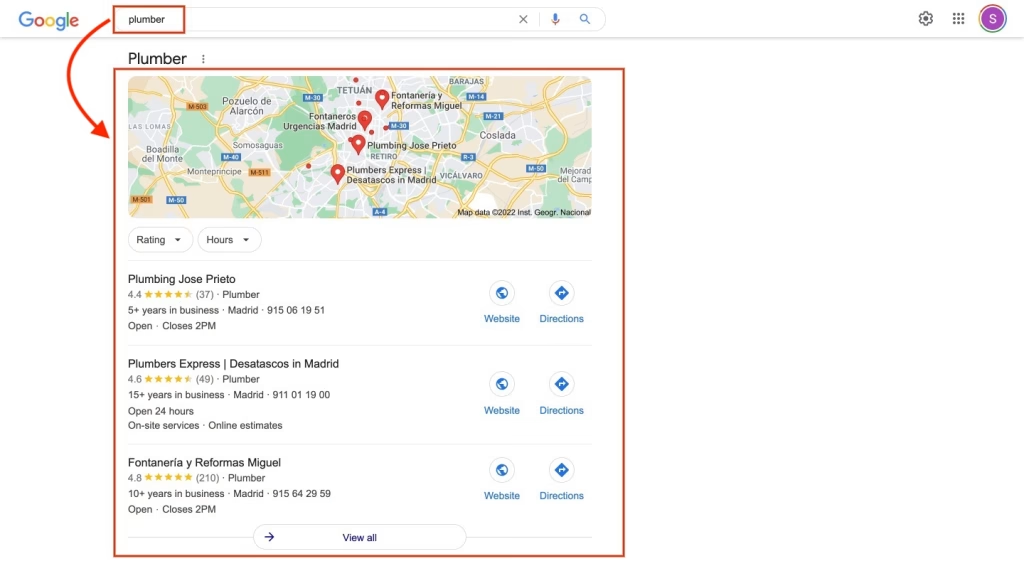
HVAC SEO in 2026 means two jobs at once: ranking in Google Maps and search for heating and cooling work in every city you serve, and being named when a homeowner asks an AI tool who to hire. Emergency calls still come from Maps and from people who are already uncomfortable. The bigger tickets, system replacements, ductless installs and maintenance plans, get researched first. That research increasingly happens inside AI answers.
Here's the short version:
- Seasonal spikes make HVAC rankings unforgiving. If you are not visible before the first heat wave or cold snap, you miss that cycle.
- Emergency jobs are won on Google Business Profile. Planned jobs are won on content, city pages and AI answers.
- AI engines cite a narrow set of sources. Across more than 70,000 AI citations we have tracked for clients, Houzz and Reddit come up far more than anything else, followed by directories and best of articles.
- One of our HVAC and plumbing clients in San Diego, Coastal Comfort, went from 2 percent to 43 percent of tracked AI answers naming them.
Why HVAC Search Behaves Differently From Other Trades
Most trades have steady demand. HVAC does not. Demand arrives in waves tied to weather, and the waves are short. A homeowner whose air conditioner quits on the first hot weekend of the year is not comparing options. They open Maps, call the first two or three companies with reviews and a local address, and book whoever answers.
So the emergency side of HVAC SEO is mostly a Google Business Profile problem. Categories, services, service area, photos, review volume and how fast you reply to a call all decide whether you get that job.
The planned side is a completely different search. Someone deciding whether to replace an aging furnace, add a ductless head to a converted garage, or sign up for a maintenance plan takes days or weeks. They read, they ask questions, they compare. In 2026 many of those questions go to ChatGPT and other AI tools rather than a search box. Homeowners now ask AI who to hire, and the answer they get is short. It names a few companies. If you are not one of them, you never entered the conversation. That is why the planned jobs, the ones with the best margins, are where AI visibility matters most.
Getting the Google Business Profile Right for Heating and Cooling
Your profile is the most important single asset in HVAC SEO, and it is also the part most owners have left half finished.
Categories and services
Pick the primary category that matches the bulk of your revenue, then add the secondary categories that genuinely apply to heating, cooling, ductwork and indoor air quality. Under services, list the actual jobs you sell, written the way homeowners say them. Air conditioning repair, furnace replacement, ductless mini split installation, duct cleaning, maintenance plan. Those entries are read by both Google and the AI engines that pull from local business data.
Posts and photos
A profile that goes quiet looks closed. We publish Google Business Profile posts and upload images on a schedule for every client, because consistent activity and fresh photos of real jobs do more for Maps ranking than most owners expect. Our Local SEO plans handle that cadence so it does not land on your service manager's to do list.
Review replies
Reply to every review, good and bad. Replies are indexed text, they give you a natural place to mention the city and the type of work, and they tell a homeowner reading your profile late at night that somebody is paying attention. Review replies are part of every plan we run, starting at the Intro level.

A Google Business Profile for a heating and cooling company showing categories, services and recent posts.
City Pages, Service Pages and the Structure Underneath
Most HVAC companies cover a wide area with a single page naming the whole region. One page cannot rank for ten cities.
The structure that works is simple. One clear page per service, written for a homeowner rather than a technician. One page per city you actually want work in, with content specific to that city. Internal links connecting the two. Structured data so search engines and AI crawlers can read what the business is and where it works. Fast load times, because people searching for emergency HVAC work on a phone will not wait.
Every site we build includes service and location pages, structured data and an llms.txt file for AI crawlers. For more detail on the mechanics of Maps ranking itself, our guide to ranking number one in Google Maps in 2026 covers it step by step.
| Job type | Where the homeowner looks | What wins it |
|---|---|---|
| No cool, no heat, emergency | Google Maps, phone in hand | Profile completeness, reviews, answering the phone |
| System replacement | Search plus AI answers, over days | Service pages, city pages, being named in AI results |
| Ductless install | AI answers and research articles | Content depth, citations on sources AI reads |
| Maintenance plan | Search and AI, often comparing companies | Reviews, review replies, directory presence |
Being Named on the Sources AI Engines Read
AI answers are not pulled out of the air. Each engine reads a set of sources it trusts and cites them. We track AI visibility for clients across six AI engines every month, running a set of real customer prompts for the client's trade and cities on a schedule, recording whether the business was named, where it appeared in the answer, and which sources the answer cited.
What that tracking shows is consistent. Houzz and Reddit are cited far more than anything else, followed by directories and best of articles. So HVAC AI visibility is less about keywords and more about existing, accurately and consistently, on the handful of places the engines keep going back to. That means listings management, citation accuracy, AI citation placements and listicle placements, which is the work behind our AI Search Visibility service.
Coastal Comfort, an HVAC and plumbing client in San Diego, is our clearest example. They went from 2 percent to 43 percent of tracked AI answers naming them. The work was a clean site, correct listings everywhere that mattered, and deliberate placement on the sources those answers cite. For the plain English version of how this works, we wrote a guide to generative engine optimization for contractors.
Timing, Because HVAC Does Not Wait
SEO compounds, which is why our plans start with a six month commitment and then run month to month. For HVAC the implication is seasonal. Work started in the slow months is what pays during the busy ones. Starting in the middle of a heat wave means the gains arrive after the rush.
New clients generally start near zero on tracked leads and climb as rankings take hold. We report phone calls and form fills every month so you can see that curve. Our SEO plans also include a three month out. If there is no measurable improvement by month three, you can stop.
What We Do, and How to See Where You Stand
TwentyOne Solutions is a local SEO and AI visibility agency for contractors and the trades, based in San Clemente, California, founded by Tyler Huff. We work with HVAC and plumbing contractors alongside painters, pavers, line stripers, landscapers, fence and deck builders, remodelers and home builders, across California and in Nevada, Florida and South Carolina. All of the work is done remotely and every ranking scan covers the client's own service area.
Intro SEO is $279 a month. Local SEO Lite is $499 a month and adds blog posts, listings management across 50 or more directories, AI visibility tracking and missed call text back. Local SEO Full is $979 a month with double the volume plus backlinks, AI citation placements and review request integrations. It is all on our Pricing page, because we publish our numbers instead of making you sit through a sales call to hear one. You own your domain, website, content and reviews, and they stay yours if you leave.
If you run a heating and cooling company and want to know where you stand, start with our marketing for contractors page and request the free visibility report. It shows exactly where your business shows up on Google and in AI answers across your service area.
FAQs
What is HVAC SEO?
HVAC SEO is the work of making a heating and cooling company visible when homeowners search for that work in your cities. In 2026 it covers Google Maps and organic search plus AI answers from tools like ChatGPT. The pieces are a fully built out Google Business Profile, clear service and city pages, accurate listings, reviews with replies, and presence on the sources AI engines cite.
Should an HVAC contractor focus on emergency calls or planned jobs?
Both, with different tactics. Emergency calls come down to Maps ranking, review count and answering the phone, which is why our Lite and Full plans include missed call text back that fires an automatic text within seconds. Planned jobs like replacements, ductless installs and maintenance plans are researched over days, so they depend on content and AI visibility.
How long before HVAC SEO produces leads?
New clients usually start near zero on tracked leads and climb as rankings take hold, which is why our plans begin with a six month commitment before going month to month. We report calls and form fills monthly so progress is visible. Our SEO plans include a three month out if there is no measurable improvement by then.
How do we get our HVAC company named in AI answers?
By being present and accurate on the sources those answers draw from. Our tracking across more than 70,000 citations shows Houzz and Reddit cited far more than anything else, followed by directories and best of articles. We also ship every site with structured data and an llms.txt file so AI crawlers can read it cleanly.
Want to know where you stand in your local market?
We will put together a free analysis of your local market, where you rank on Google and in AI answers across your service area, and what it would take to move up.
Get My Market Analysis