A homeowner in San Clemente pulls out a phone, types plumber near me, and calls somebody inside of five minutes. You either show up in that moment or you do not. The part most contractors get wrong is treating near me as a keyword to optimize for. It is not one.
Google is not looking for the words "near me"
Google treats most contractor searches as local whether or not anyone types the phrase. Search plumber from a phone in Dana Point and you get a map with local listings on it, the same as if you had typed plumber near me. The phrase is a habit people picked up. It is not a switch that flips.
So there is nothing to rank for. What you are actually competing on is what Google says it weighs for local results: relevance, distance, and prominence. Those three come straight out of Google's own Maps ranking documentation, and every useful thing you can do falls under one of them.
What those three actually mean
- Relevance: how well your Google Business Profile matches what was searched. Your primary category does the most work here. Secondary categories, your service list and your description fill in around it.
- Distance: how far you are from the searcher, or from the city they named. The least controllable of the three. It is also why a contractor can own one town and be invisible fifteen minutes up the freeway.
- Prominence: how established and trusted you look. Reviews, citations, website strength, how active the profile is. This is where the real work happens, because it is the part you can build.
The Map Pack and the blue links are two separate races
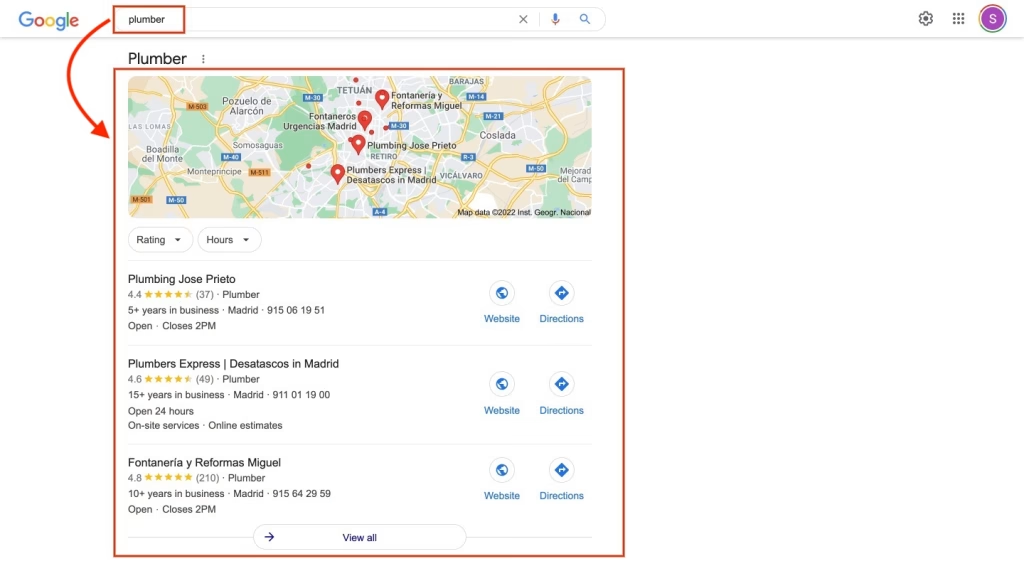
That block of listings on the map is the Map Pack, and it runs mostly on your Google Business Profile. The regular results underneath it run mostly on your website: your pages, your content, your links.
The split matters more than people expect. A contractor with a strong profile and a thin website shows up on the map and then loses the click, because the person taps through to a homepage that never mentions the service they searched for. A contractor with a good website and a neglected profile never makes the map at all, and the map is where the first calls come from. You need both, and they need to tell the same story.
If you drive to the customer, hide your address
Contractors who work at the customer's property should run a Service Area Business profile: street address hidden, cities or ZIP codes listed instead. Two things go wrong here constantly.
- A visible home or garage address that no customer will ever visit. It muddies the location signal and it reads as unprofessional to anyone who clicks through.
- A service area the size of a county. Claiming all of Orange County when you really work San Clemente through Laguna Niguel spreads you thin. List the cities you would actually drive to tomorrow.
The profile work that moves you
- Pick the most specific primary category that fits. Roofing Contractor beats Construction Company. HVAC Contractor beats Contractor. This one field carries more weight than anything else on the profile.
- Add secondary categories for work you really do. You get several, but padding the list with services you do not offer makes the profile less relevant, not more.
- Fill out the services list and give each one a short description that pairs the service with a place, phrased the way a customer would say it.
- Upload real job photos. Not stock, not renders. Before and after shots off the truck, your crew in branded gear, the equipment you actually run.
- Post about once a week. A finished job, a seasonal reminder, a question you get asked constantly. It keeps the profile looking alive.
- Set the attributes that match how you work, like online estimates or emergency service. People filter on those.
Reviews are the prominence lever you control
Volume helps, but a steady drip of recent reviews does more for you than one big push. Most of the contractors we work with have the same problem: a decent star rating where the newest review is two years old. That profile reads like a business that used to be busy.
Ask on the spot, at the end of the job, while the customer is happy and standing right there. A short link or a QR code on the invoice gets answered. An email sent three days later, once the job is out of mind, mostly does not.
Then reply to all of them, the good ones and the rough ones, inside a day or two. Mention the service and the city when it reads naturally. Never force it.
The Simple Version
Recency beats volume. Ten reviews from this quarter say more about your business than sixty from 2022.
Your website has to back up the profile
- One page per main service. Roof repair gets its own page instead of a bullet point buried on a general Services page.
- One page per city you actually serve, written like somebody who has worked there. Salt air chewing through fasteners in Capistrano Beach. Older tile roofs in San Juan Capistrano. Hillside drainage in Laguna Niguel. That specificity is the entire value of a city page.
- Do not template one page and swap the city name. Those pages are obvious to a reader and obvious to Google. They read as thin and they do not hold rankings.
- Pair the service and the place in the page title and the H1, the way somebody would search it out loud.
- Link service pages to the matching city pages, and link back the other way, so the work you do and the places you do it are connected.
The unglamorous parts that still count
Your business name, address and phone number should be identical everywhere they appear. Your website footer should match your Google profile character for character, because St. and Street are two different things to a machine. Keep the URLs simple and readable, something like /services/roof-repair and /service-area/dana-point.
Watch your site speed on mobile. A lot of these searches happen from a driveway on two bars of signal, and a slow page loses the call to whoever loads first. Then pick up the local links that are sitting there for free: the chamber of commerce, your suppliers, manufacturer dealer directories, the youth team you sponsor. Small links, but they tie your business to a place.
How to tell whether it is working
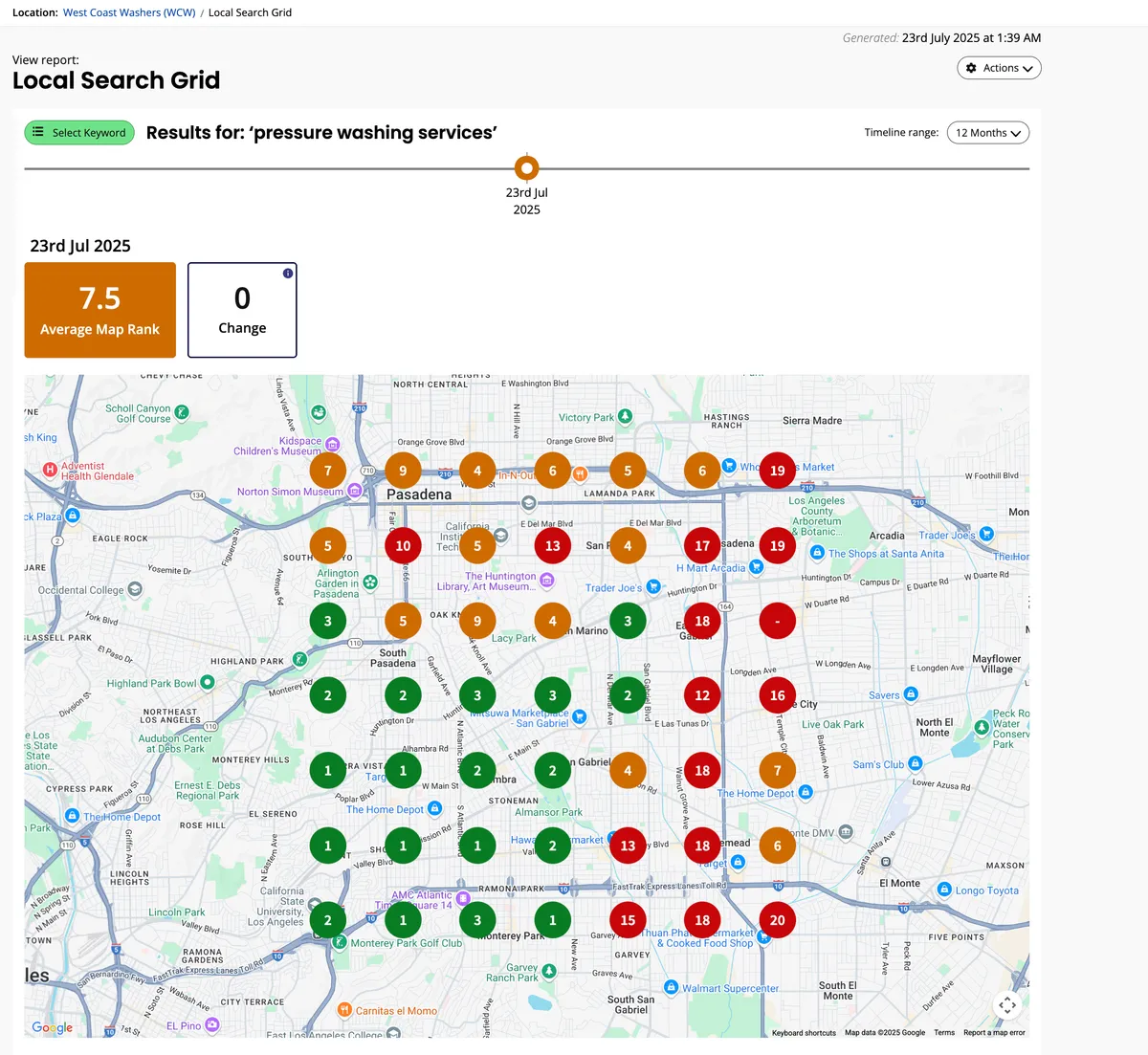
Checking your own ranking from your own phone tells you close to nothing, because you are checking from one spot, usually your shop, where you already rank best. Grid rank tracking runs the same search from dozens of points across your service area and shows you where you are strong and where you vanish. Turning that map green is the actual job.
Alongside it, read your profile dashboard once a week: calls, website clicks, direction requests, and whether people found you by name or by searching the service. Add call tracking so you can tell a call that came off the map from one that came off the website.
Expect months, not weeks. Profile fixes can move things reasonably fast. Reviews, citations and new pages compound slowly, and competitive terms in a crowded market take the longest. Anybody promising you a Map Pack spot on a fixed schedule is guessing.